
Bears are piling on as much weight as they can to make it through the long cold ahead, squirrels are filling their larders, and I should be storing summer furniture and trying to keep mice out of my house. Instead, I feel languorous, sleepwalking through an amber haze.


Golden yellows are all around, a seemingly endless, glowing path to winter. The air, grass, trees, water–everywhere I look– are shimmering in a halo of yellow. There is no name for this seasonal transition that I know of, but it makes me feel warm and oozy, mellow, and as sweet as honey.
Seeing red is a term used to describe anger, but also to describe the brief but brilliant reds that nature displays after the fall foliage fades. I have been seeing red for weeks. Autumn has been a hot, vibrant frenzy of blueberry leaves, sumac, and rose hips. Now, it has tranquilly faded to yellow. The star? Probably the seasonal gold of Maine’s only deciduous conifer, the Eastern Larch, Larix laricina.


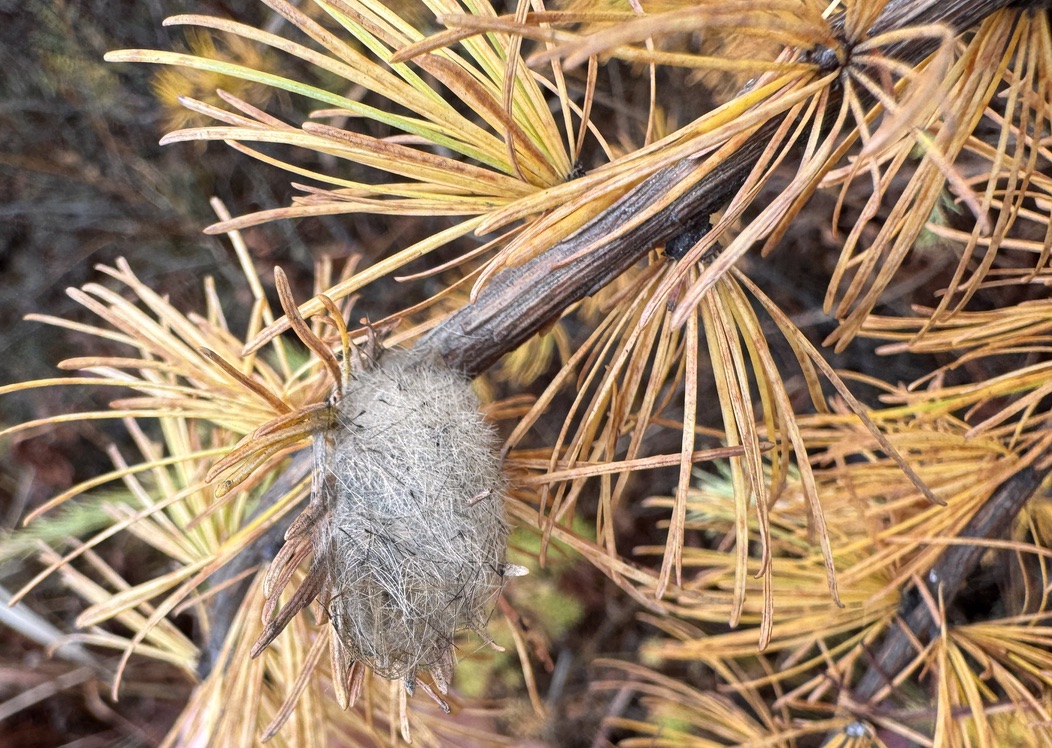
Eastern larch, commonly called tamarack or hackmatack, is in the same genus as the western larch, Larix occidentalis, but unlike those who live near western larch, we get these trees all to ourselves. Larch Madness, which is causing traffic jams and otherwise sane people to sleep in their cars to catch the color, is gratefully a Pacific Northwest phenomenon. Our larches are smaller, not shrouded in snow, and grow in bogs rather than lofty mountain heights.Their color is equally spectacular, however. Tamarack often grows side by side with black spruce or other conifers, creating a striking contrast between its soft yellow needles and the dark waxy greens of the spruce.
Dropping its needles is a strategy that allows tamarack to survive not only in Maine, but in northern Canada, where temperatures can drop to -85° F. Needles offer a surface where water can evaporate, drying a tree out, and also catch snow which is heavy and causes branches to snap. By dropping its needles, tamarack avoids both these winter threats. In the process, we are treated to a glorious annual color shift.


Late October and November have a few other glowy tricks. Roses, which had green leaves all summer, now turn yellow before browning and falling to the ground. Chlorophyl, which made them appear green, breaks down revealing underlying carotenoids, which are yellow pigments. The red rose hips are brilliant against the yellowing leaves.
Norway maples, Acer platanoides are not native, and miss the red phase entirely. They shift from green straight to a sunny or lemon yellow, vibrant against the tar-colored black spot fungus.This fungus is just cosmetic, on the surface of the leaf, and doing little harm to the tree.
Asters bloom until a killing frost comes along and kills them. Until then, the cheerful yellow centers, made up of many disc flowers, continue to attract pollinators including bee mimics with their own sporty splash of yellow.


Along the coast it is hard to miss the glorious glow of rockweed, Ascophyllum nodosum. This luminous color will darken to a darker green as temperatures drop.
The yellows of nature in late fall do not scream like the reds, or entice leaf peepers like the rainbow hues of October.They just glow, and it is impossible to bask in that glow without decompressing, and sighing in relaxation.
Yellow gives us so much, and yet it is not a favorite color for most people. It ranks a sad sixth place after blue, red, green, purple, and pink. But songs and phrases may be popularizing this color of warmth and optimism. Has anyone called you their yellow lately? It means you are a special person in their life, human sunshine. I’ll take that over being blue.
Until the leaves all fall, the bee mimics die or hide, and the mushrooms decay, I will be busy looking at the glow and feeling its warmth. And you? I hope you get out there, too. You’re my yellow. (But don’t tell anyone about our larch.)

I have been reveling in all of the colors of autumn; now I find myself looking for the more subtle signs, quieter shades on smaller pallets. Thank you for highlighting all the yellows!