
I often say “buckle up” as I start on a long-winded tangent about what’s in leaf litter, or why clam flats smell. I may have to change that to “Hold Fast!”
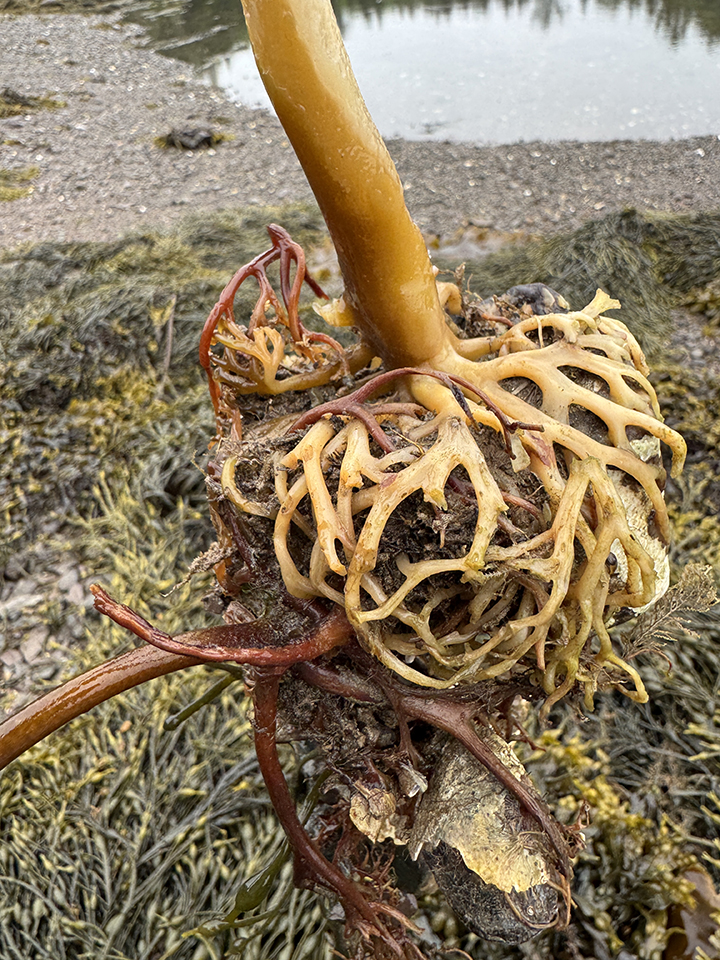
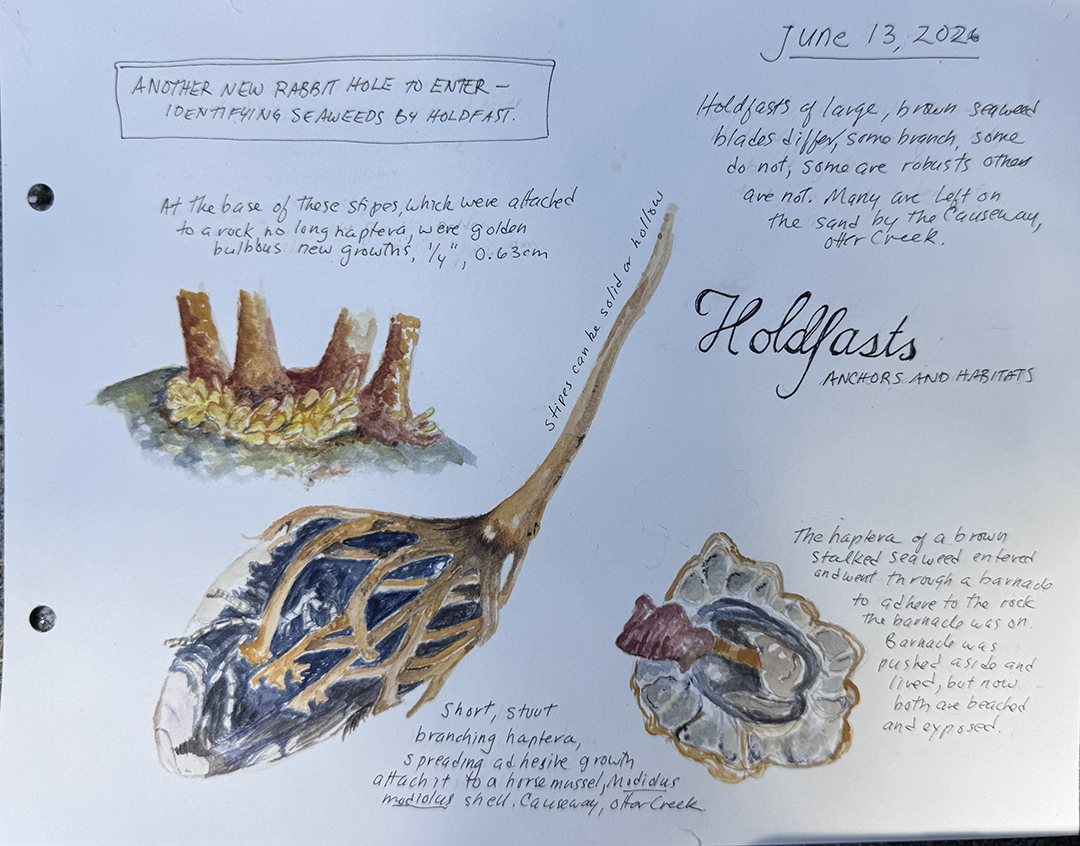
I have been wading around our rocky shores at low tide because it is summer. This time I was looking for some large northern horse mussel shells, Modiolus modiolus, for a workshop on tidal adaptations. The ones I found on the flats had kelp holdfasts attached to them, though little remained of the kelp blade.
The snarly tangle of kelp growth on one horse mussel shell was firmly cemented in place. A kelp might be wise to anchor itself here. This mussel in turn might be attached to a community of fellow horse mussels. Horse mussels can live singly, but often form large beds.They do this with their remarkably strong byssal threads, which are made of proteins excreted by glands in the mussel’s foot. If you go musseling for the delicious relative of the horse mussel, our native blue mussel, Mytilus edulis, you will be familiar with the impossibility of pulling up just one mussel. Even spotting a choice, big cupped, and large specimen, knowing you only want that mussel, you still end up with a half dozen of your chosen mussel’s closest neighbors as well, along with some mud and bits of rock you didn’t want.
The kelp may be attached to only one mussel shell, but the entire mussel bed is keeping it anchored to the ocean floor. It is using its holdfast to anchor to the mussel, which uses its own holdfasts, the byssal threads, to anchor to the mussel bed.
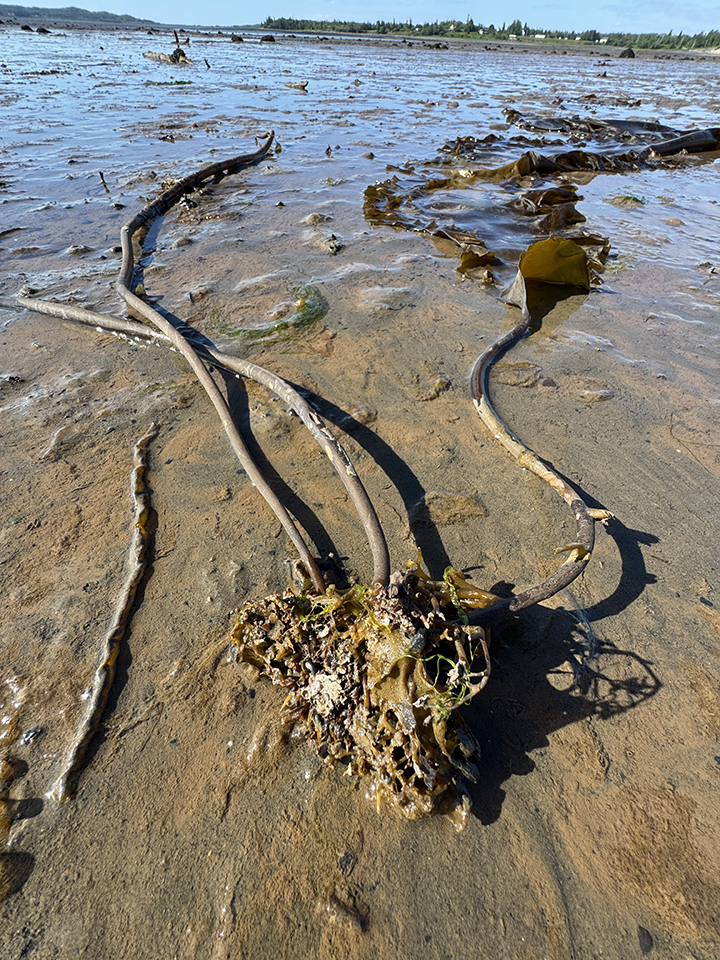
Life is turbulent in the intertidal zone. Staying in place is important. Whatever lives there needs to find food, not get eaten, stay moist when the tide is out, and not get ripped out and cast adrift into the wide scary ocean. That is where holdfasts come in handy.
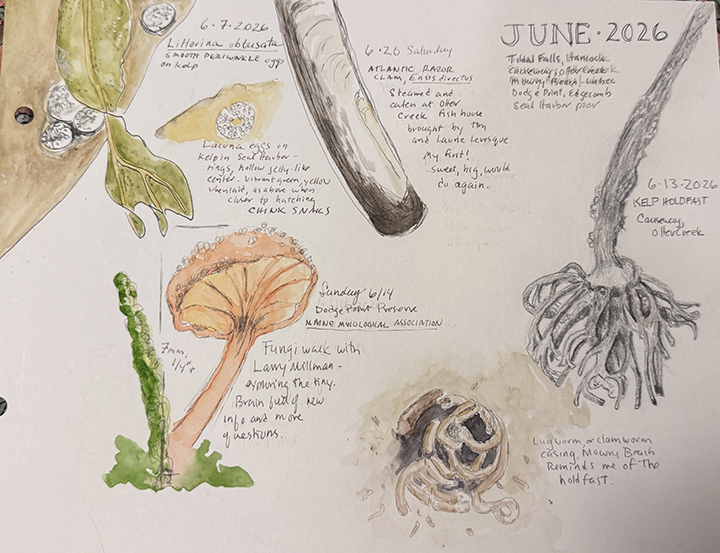
Holdfasts come in a variety of styles, the tangled branches of the kelps, called haptera, the byssal threads of the mussels, and the various disc-tipped holdfasts found on many smaller marine algae such as Fucus, Ascophyllum and Chondrus crispus.
The kelp holdfast resembles a woven basket. There is space in between all the branches, and a single holdfast can harbor hundreds of tiny life forms, providing safe homes for amphipods, isopods, tube worms and even small crabs. The one on my mussel shell has been tossed about by waves then stranded high up on the shore. I can see a tiny empty clam shell, and a blue mussel perhaps one quarter inch long, but most of the creatures who lived there have left. With my hand lens I see deep through the twisting branches of the haptera, tempting me to enter and explore all those dark corners and tunnels, but of course I am too large.
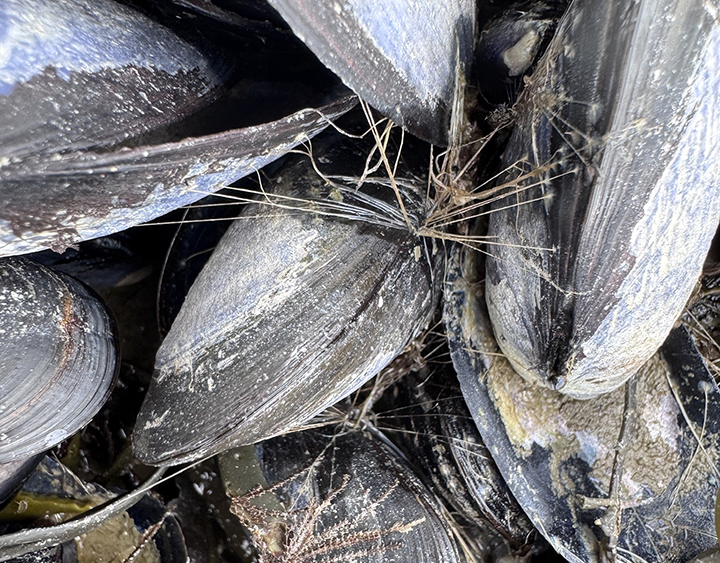
The mussels use their holdfasts for more than anchors, and when I kept a salt water tank I watched multiple times as they adhered new byssal threads to the aquarium glass, pulling themselves to a position they preferred, maybe a bit farther away from the agitation of the filter. It takes only a few minutes to make a new thread. The mussel puts out its foot and glands create protein which pours through a groove.The hardening protein in the groove is covered with a waterproof glue, the mussel stretches this thread, and it cures. It takes fifty to one hundred threads to anchor the mussel securely in one place. If you have ever scrubbed mussels for dinner, you know how tough and wiry these threads are. Mussels are delicious and worth every bit of effort, but there’s so much more to this story.
Buckle up! (or hold fast…) Mussels kill marine snails with their threads!
As filter feeders, seawater is constantly flushing through their system when underwater. Sensory organs in the mussel’s siphon and mantle can detect the presence of chemicals. Predators that want to eat mussels, including the dog whelk, Nucella lapillus, give off identifying chemical cues called kairomones whether they want to or not. A whelk softens a mussel’s shell with chemicals then drills a hole in it. Next it inserts liquifying enzymes, turning the mussel to mush, which can then be sucked up through the whelk’s proboscis. This process can take days.
Mussels’ chemosensors can also pick up necromones, which are the chemical cues emitted by a dying mussel. Think necromancy, and nekros, Greek for corpse. When warned a nearby mussel is being attacked, and they may be next, there are options for survival. Dog whelks are very slow-moving. It takes four to eight hours for them to drill a hole into a shell, liquefy the mussel, and slurp it up. From my human viewpoint, that is not a pleasant death.
Fight or flight, they can choose. Some younger mussels send out new byssal threads and move away. Other mussels put a byssal thread on the snail’s shell and a nearby rock, tying it down until it starves. This fills me with awe and admiration. Having never seen this I went to my nearest mussel bed to peer more closely, hoping to see an unwary whelk held captive with those tough brown threads. And there it was, a pale dog whelk, strapped and immobile. I have probably seen this many times without understanding what I was seeing. Now I will always see it and know it for what it is, murder on the high seas.
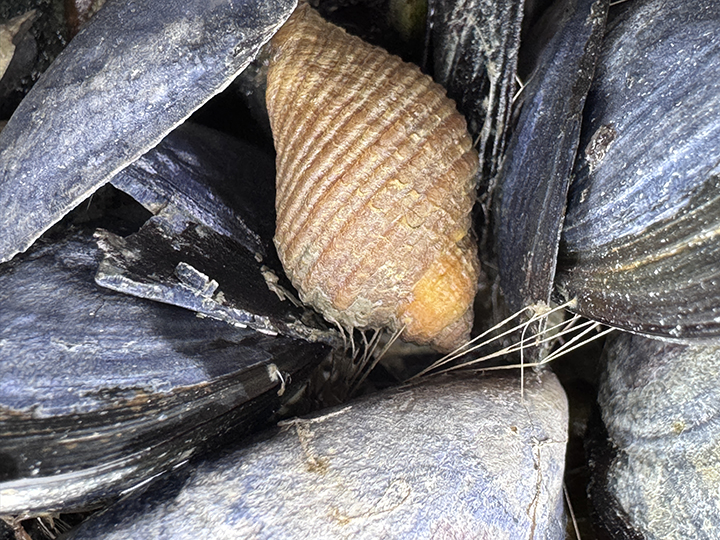
From a tidal point of view, give me the cosy shelter of a kelp holdfast instead of the communal but still vulnerable mussel bed. I don’t want to mess with dog whelks, however slow moving. I think I prefer to make like a kelp, twine my arms around someone, and holdfast.
If you want to dig deeper into mussels against whelks:
Karen,
This is a great article. Even I can understand it.
You are a wealth of amazing facts. So entertaining,too! I always have a million questions. I’d really learn a lot if I lived near you.
Thanks, from your big sister. Kathy
artful, clear and compelling! all of us benefit both when we hold fast and when we know when to let the tide take us!
Ahh, “when to let the tide take us” That is a question worth pondering.