
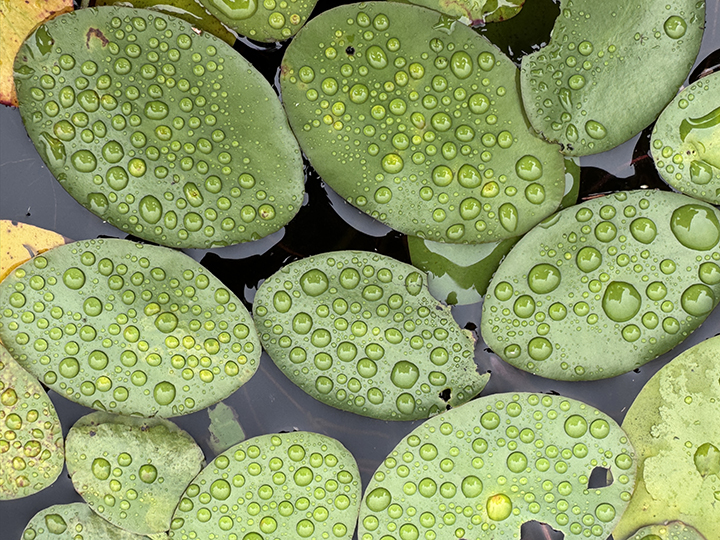
Flat bright green leaves rest on the surface of our ponds and lakes in the summer, creating floating waterbeds for snoozing frogs. Those frogs are not alone, they have a lot of company from flying, crawling, tunneling, and at times unmoving neighbors.
Riddled with squiggly tracks of a leaf miner, punctuated with chew marks from an aquatic moth, or coated with thick clear edible gel, there are three floating leaves I most often see as I walk the edge of a pond. Each plant has its own unique leaf blade and its own unique flower, including the female one day, male the next, watershield. The more I watch, the more I see. They all have their surprises.
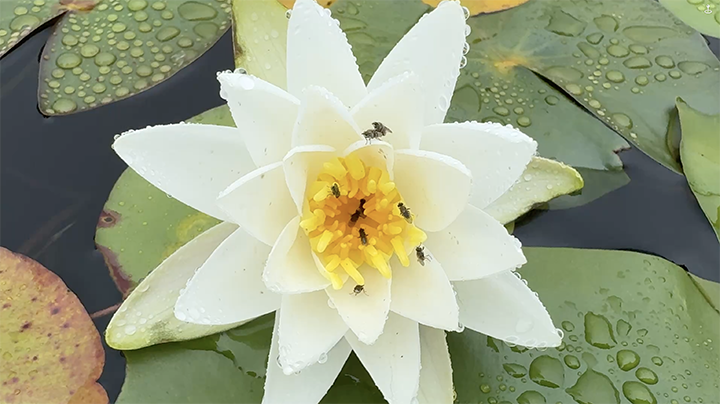
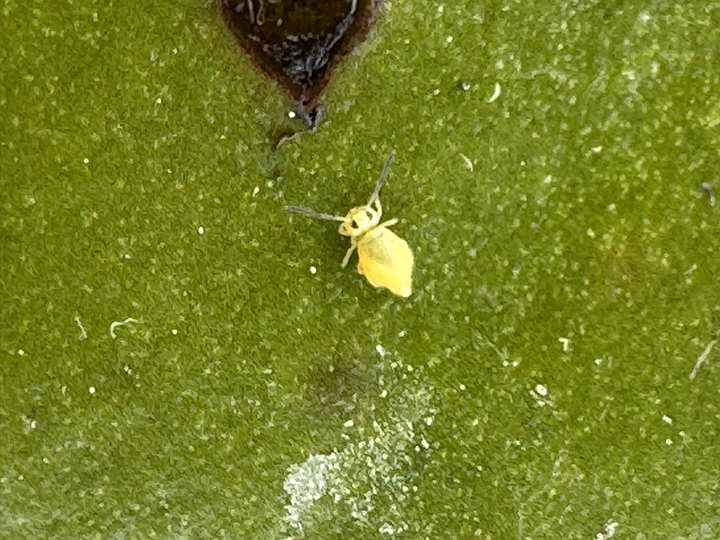
The aptly named Fragrant water lily, Nymphaea odorata not only smells sweet, its flowers are stunning–the striking white starbursts that most people think of when they think of waterlilies. They (and a close relative) have been memorialized by French impressionist Claude Monet in over 250 paintings. But did he ever look under the leaves? Or look at all the life milling about on top of the lilypads? A pond near my house has mostly Fragrant water lilies. After watching all the small flies cavorting and mating on the flower I turned to the leaves. The squat springtails stood out pale yellow against the green. In the class Collembola, these wingless arthropods eat algae and need moisture. These keyed to order Symphypleona, which are described as globular, which they were.
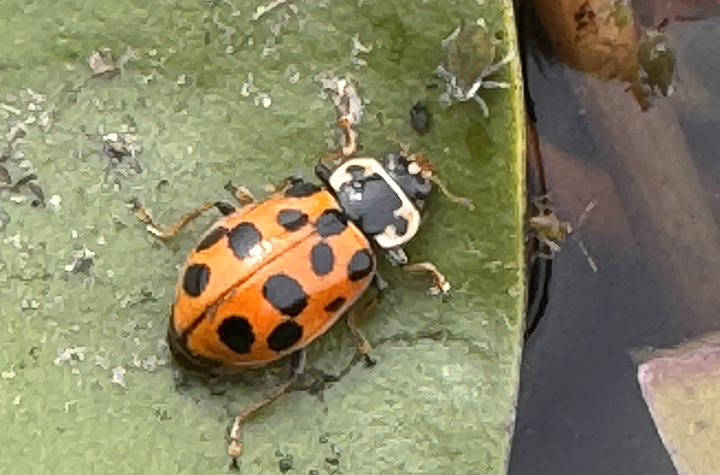
BOTTOM: 13-spotted lady beetle, Hippodamia tredecimpunctata near two black water-lily aphids, Rhopalosiphum nymphaeae.
One pad away were several dark aphids, probably water lily aphids, Rhopalosiphum nymphaeae, moving deliberately, neither slow nor fast, maybe grazing along the slightly curled edge of the leaf. Near them was a brightly colored 13-spotted lady beetle, Hippodamia tredecimpunctata. This native Lady beetle dines on those little black aphids, so no surprise to see one in their vicinity.
A few quarter-inch long flies with an orange thorax never kept still enough for me to take a photo. A ID program called them dance flies, and while I wish I knew more, I have to admit that’s exactly what they seemed to be doing.
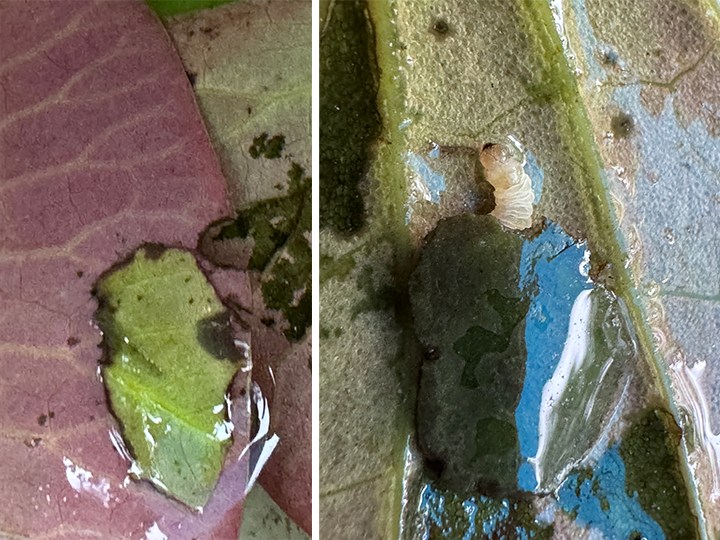
I flipped a leaf over, and there was another entire world. The leaf changed from flat and green to having strong veins radiating from the stem and a deep pink color. A brown snail was moving along the surface. With a 20x hand lens, a yellow lump transformed into two rows of oblong eggs. And there, looking like it was glued on, was an oval piece of leaf, not even remotely camouflaged against the reddish surface. I looked at the bottoms of more leaves, and found a few more of these odd patches, reminding me of the visible mending a friend once did on my messenger bag. Peering at one after another, I finally noticed the puffy white edge of a larva sticking out from one. Then an oblong cut out piece of leaf floated by. I picked it up. It had another piece attached to the bottom, like a sandwich. This mystery waited until I got home.
Below: Nature journal page of Fragrant Water Lily.
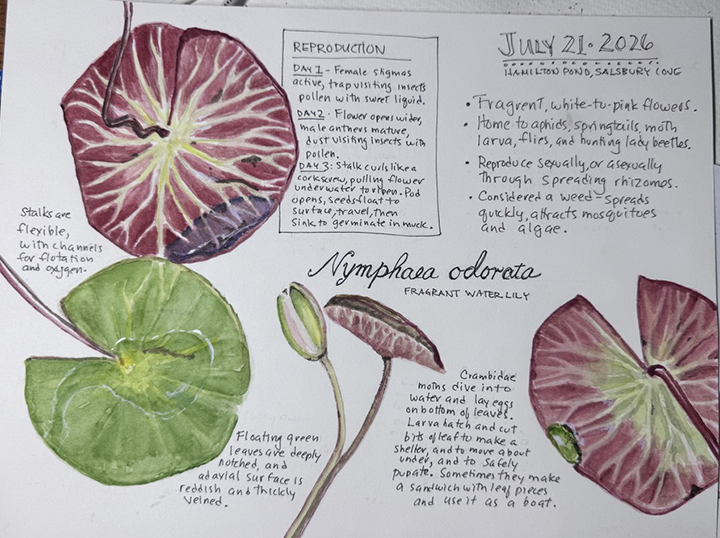
Whoa! Aquatic moth larvae–moth larvae that spend their entire egg and larval stages submerged! And underwater swimming moths! Some Crambid moth females dive into the water as adults, and lay their eggs on the lower surface of a water lily leaf. They even have legs modified to act as paddles. Not sure what happens after ovipositing, maybe she drowns. When the eggs hatch, the larvae chew the leaf for food, and also chew a rounded piece to hide under. And sometimes they use the bits of leaf they have cut as a boat, to go sailing off to greener pastures, or tastier leaves. My mind is still spinning. A moth larva that lives under water and builds a boat to travel around the pond! The larva and leaf boats I saw might be a Waterlily Leafcutter Moth or Chalk Mark, both in genus Elophila. Time to calm down and look at another plant.
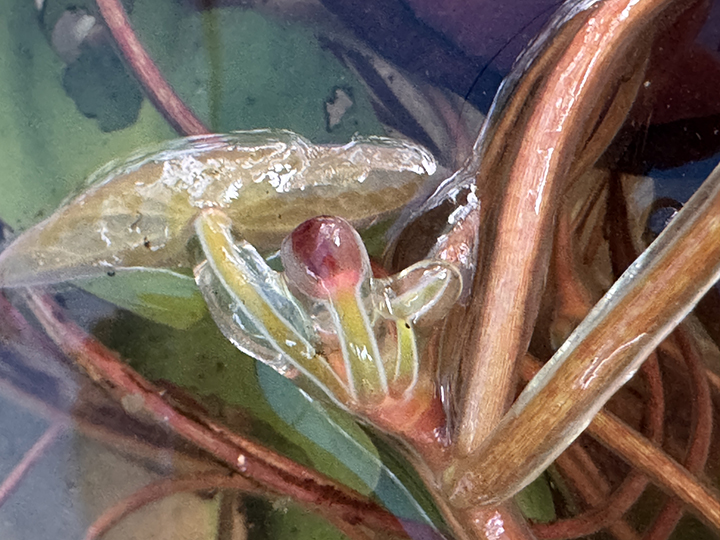
In spite of not having moths swim to it, Brasenia schreberi, watershield, is my favorite of these three plants. It is considered borderline invasive, so I had no qualms about collecting a bit. This is easier said than done, however, as getting a grip on its slimy, gel-coated stem requires a firm grasp and unflinching attitude.
The thick mucilage that coats the stem, buds, and bottom of leaves is clear as gin, and contains polysaccharides which reduce cholesterol in hamsters. While this health benefit is not confirmed in humans, watershield is a prized delicacy in Japan. Called Junsai, the slippery leaves are served chilled with a vinegar or soy sauce and wasabi dressing. We have pick-your-own apples or strawberries as local farm experiences–Japan offers similar events for watershield, where visitors can lay in the bow of a boat and harvest the buds themselves. I nibbled a few buds straight from the pond, and found them lacking in flavor, but having a satisfying crunch.
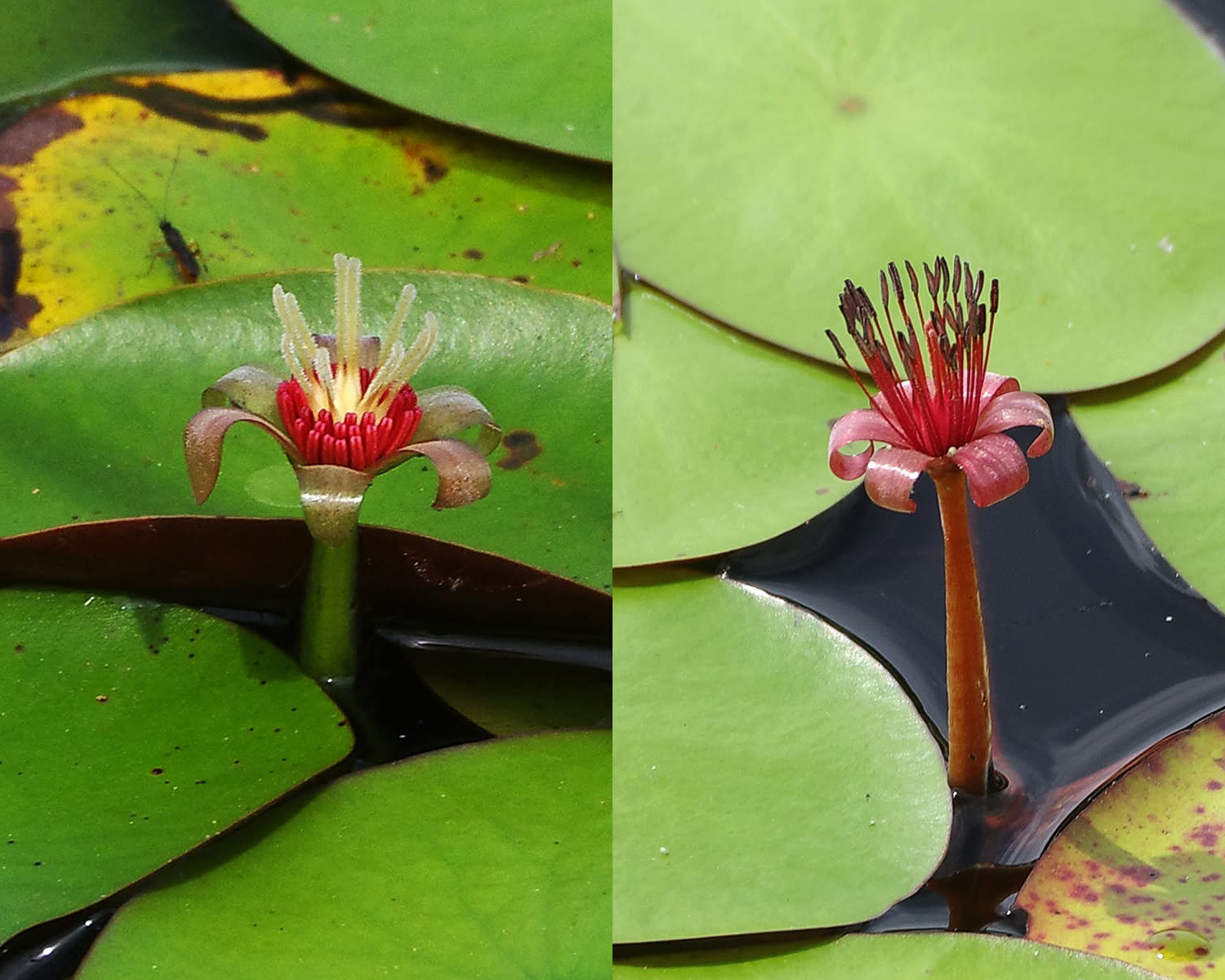
I love playing in the shallows with watershield, trying to grab it, feeling it slip away, and rubbing my fingers along the gel, which does not come off on your hand. Trying to see which flowers are carpellate (with female reproductive parts), and which are staminate, (with male parts), is an annual challenge. This plant has developed a brilliant way to prevent self-pollination. Some plants make this difficult, watershield makes it impossible. This is how: It only flowers for two days. On the first day the flower has stigmas raised up to catch pollen from another watershield. Then the flower lowers itself under the water. The second day it emerges a bit higher, with anthers held aloft on filaments. The filaments dry, anthers shed pollen which drifts off into the wind. There are a few insects that transport this pollen, but the pollen is aerodynamically–shaped and designed to be wind-borne. On the first day the flower has female reproductive parts, on the the second day it has male parts, and on the third day it submerges for the last time and sets seed. I know of no other plant that does this.
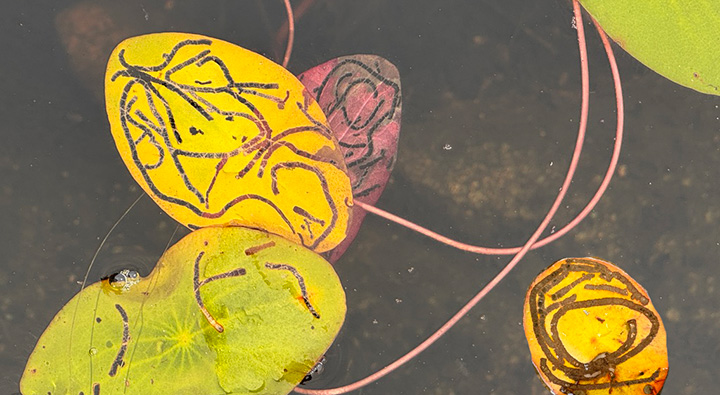
The symmetrical oval leaves are home to non-biting midges that create marvelous, no-two-alike leaf mine patterns. These are tunnels created by larvae eating the inner tissue, the mesophyll, of the leaf. I have more photos than I can count of these patterns, go look at them and you may understand my obsession. Some of these mines leave raised mounds on the leaf, others are open at top, but they do not eat through the bottom layer, or they would fall into the water. Other miners are moth larvae, which leave brownish raised trails. Next month I will be taking a class, and hopefully learn how to distinguish them
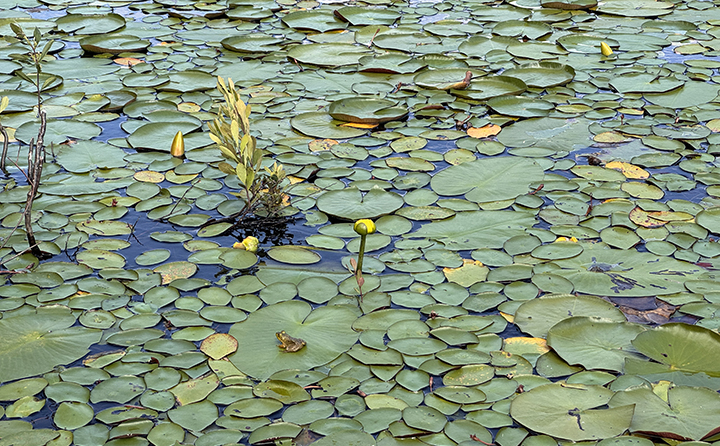
Finally, we come to Nuphar variegatum, the Yellow pond-lily, or spatterdock.
These seem to be preferred frog rests, perhaps due to size, but they too have their own leaf mining insects. Moth or midge, once again that is the question. After the insect exits, the weakened trails decompose, leaving little structure. The leaf may remain intact, or if there was a lot of mining, it will fall apart.
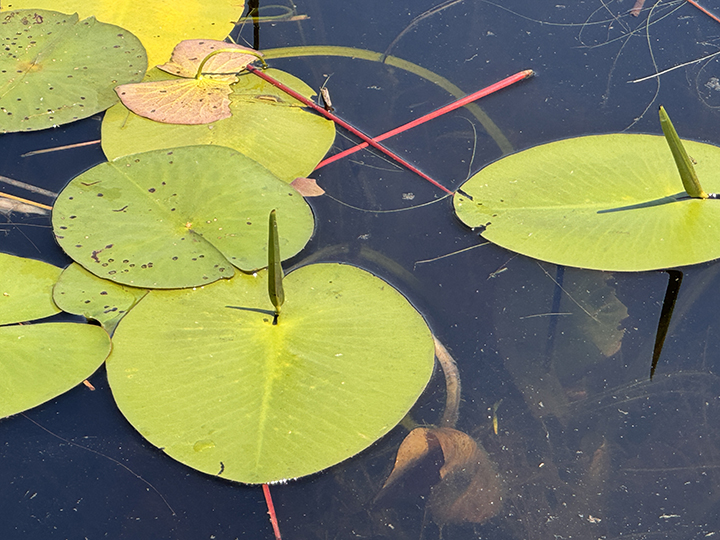
These leaves have deep notches and emerging pickerel weed, Pontederia cordata, finds its way into them. Intentional or not, looking at the growing spires of a pickerel leaf supported by a spatterdock leaf makes me wonder, “Is this really just random?” My internal jury leans towards random, thinking about spring ephemerals bursting through and lifting leaf litter, but I am ready to be persuaded otherwise.
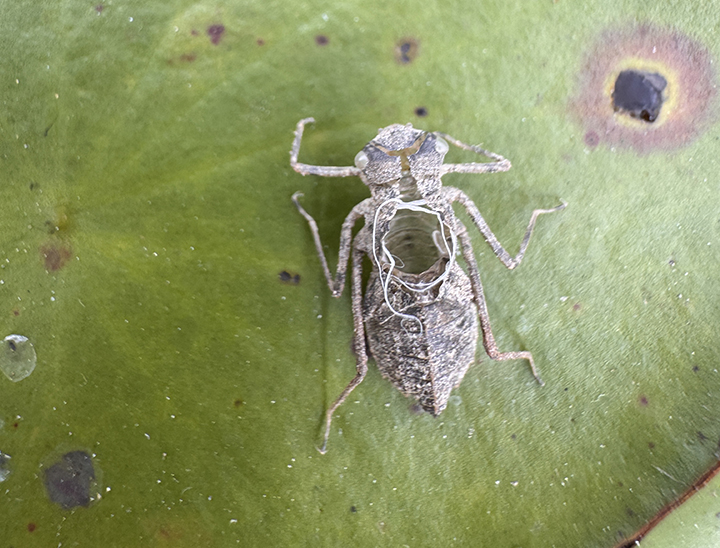
When I stop to study a lilypad I always see something I have never seen before. And yes, I do generally see a resting frog. But next time you walk by some floating green leaves in a pond take a closer look. Snails, moths, and springtails live there. Eggs are attached to mature in safety. Dragonflies balance to emerge from their exoskeleton and fly away. Don’t forget to check out the flowers, you might see spiky anthers or feathery stigmas on the watershield.
Lilypads do so much more than give frogs a place to nap. 🔹
Quick guide to these three easies.
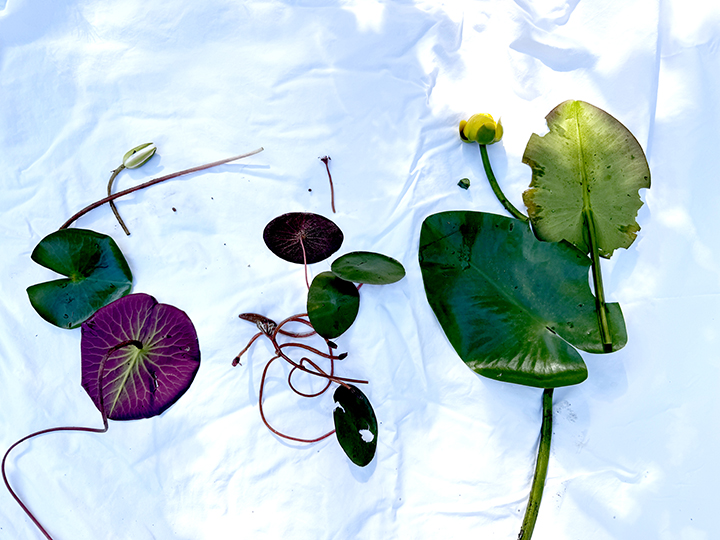
It is so easy to tell them apart there is no excuse for confusing them, and it is another reason to like them. They do not intimidate as do our willows and grasses. And so, here is my quick guide to these three plants:
Nymphaea odorata, Fragrant water lily: Largish round leaves, deep notch where stem attached, leaf red on back, round stem, white fragrant flowers. Family Nymphaeaceae
Brasenia schreberi, Watershield: Mid-sized oval leaf with stem attached in center of leaf, no notch in leaf, leaf red on back, round stem, thick gel coating, and petite pinkish flowers. Family Cabombaceae (more recent classification) or Nymphaeaceae.
Nuphar variegatum Yellow pond-lily, spatterdock: Largish oval leaf, notched leaf base where stem attaches, leaf green on back, flattened stem, yellow flowers. Family Nymphaeaceae